
Chemical exfoliation is one of the most consistently effective things you can do for skin texture, tone, and clarity, but the alphabet soup of AHA, BHA, and PHA makes choosing one feel more complicated than it needs to be. These acids all exfoliate, but they do it differently, reach different depths, and suit different skin types and concerns. This guide cuts through the noise and tells you exactly which one to reach for.
What Chemical Exfoliation Actually Does
Physical scrubs remove dead skin cells by friction. Chemical exfoliants do something more precise: they dissolve the bonds holding dead cells together, allowing them to shed on their own. The result (over consistent use) is smoother texture, more even tone, clearer pores, and better absorption of other skincare products.
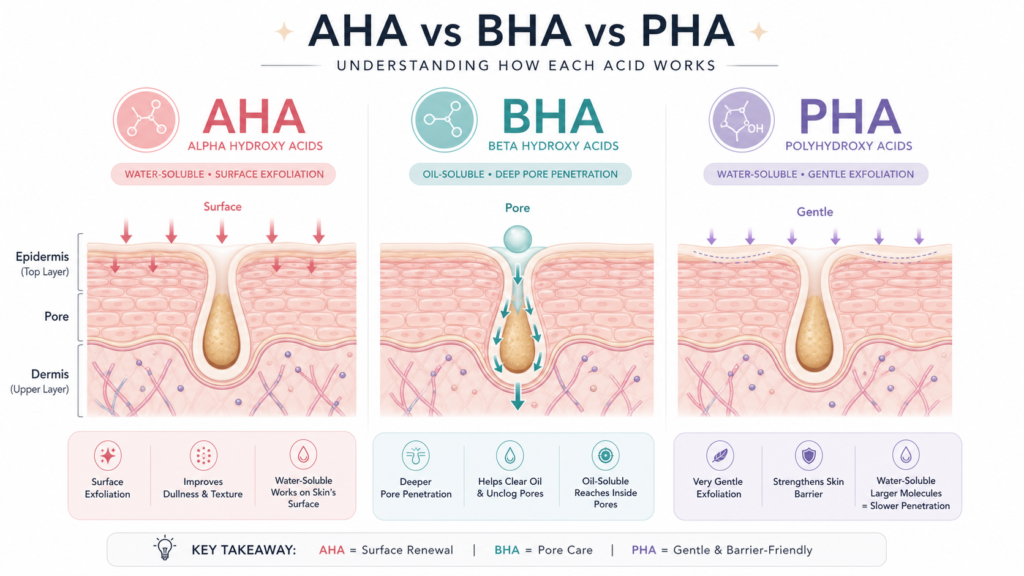
All three acid families (AHA, BHA, PHA) achieve this, but their molecular structure determines how deep they penetrate and what they can reach. That structural difference is the key to understanding which one is for you.
Quick Comparison Table
AHAs — Surface Exfoliators for Texture and Glow
Alpha hydroxy acids (AHAs) are water-soluble, so they work on the skin’s surface — breaking down dead cell bonds to improve brightness, texture, hyperpigmentation, and early signs of aging. Glycolic and lactic acid both accelerate cell turnover, reduce hyperpigmentation, and stimulate collagen with consistent use. The FDA recommends a maximum of 10% AHA concentration at a pH of 3.5 or higher for OTC products.
Within the AHA family, the main differences come down to molecular size:
- Glycolic acid: smallest molecule, deepest penetration, strongest results, highest irritation risk. Best for oily or experienced users.
- Lactic acid: slightly larger, gentler, and also pulls moisture into the skin as it exfoliates. Better for dry or sensitive skin.
- Mandelic acid: largest AHA molecule, mildest exfoliation, with added antibacterial properties. Good for acne-prone skin that can’t tolerate stronger acids.
One important note: AHAs increase photosensitivity, so use them at night and wear sunscreen every morning.
Best for: Dull skin, uneven tone, texture, fine lines, hyperpigmentation.
BHAs — Pore-Penetrating Acids for Oily and Acne-Prone Skin
Beta hydroxy acids (BHAs) are oil-soluble, which means they can travel through the oily environment inside a pore and dissolve the buildup that AHAs simply can’t reach.
The primary BHA in skincare is salicylic acid, and it works on multiple levels: it dissolves the keratin plug inside clogged pores, reduces sebum production, and has anti-inflammatory and antibacterial properties useful for active breakouts. OTC products typically range from 0.5% to 2%, with visible results at 6–8 weeks of consistent use.
Unlike AHAs, salicylic acid doesn’t meaningfully increase sun sensitivity, though daily sunscreen is always good practice.
Best for: Blackheads, whiteheads, enlarged pores, oily or acne-prone skin.
PHAs — The Gentlest Option for Sensitive Skin
Polyhydroxy acids (PHAs) have significantly larger molecules than AHAs or BHAs, which limits how deeply they penetrate, meaning slower, more surface-level exfoliation and much less irritation.
The most common PHAs are gluconolactone, lactobionic acid, and maltobionic acid. They also act as humectants, have antioxidant properties. Unlike AHAs, they don’t increase photosensitivity, so they can be used during the day.
PHAs produce improvements in texture and tone comparable to AHAs over time, with significantly lower rates of stinging and burning, making them a genuine alternative for reactive skin, not just a weaker option.
Best for: Sensitive, reactive, or rosacea-prone skin; anyone who has found AHAs too irritating; beginners.
Which One Is Right for Your Skin?
Not sure where to start? Use this as your guide:
- Oily, acne-prone, or congested skin with blackheads → Start with a BHA (salicylic acid 1–2%)
- Dull, uneven tone, or rough texture on normal/combo skin → Glycolic or lactic AHA
- Dry skin that still needs exfoliation → Lactic acid (it exfoliates and hydrates)
- Sensitive skin, rosacea, eczema, or reactive skin → PHA (gluconolactone)
- Acne-prone but reactive skin → Mandelic acid (AHA with antibacterial properties, very gentle)
- Combination concerns → AHA + BHA products exist, but introduce one at a time to gauge tolerance
How to Use Acids Safely
A few rules apply regardless of which acid you choose:
- Start once or twice a week and build up frequency gradually — daily use from day one is a reliable way to over-exfoliate
- Don’t layer multiple acids in the same routine — especially when starting out
- Always follow with moisturizer to support the barrier after exfoliation
- Wear sunscreen every morning — AHAs especially increase UV sensitivity for up to a week
- Don’t use on broken, sunburned, or actively irritated skin
- Stinging that settles within a minute or two is normal; burning that lingers, significant redness, or peeling is a sign to pull back on frequency or concentration
🧪 Lab Verdict
AHAs, BHAs, and PHAs all exfoliate, but they’re not interchangeable. BHAs are the only acids that can actually get inside a pore, which makes salicylic acid the clear choice for blackheads and congestion. AHAs work on the surface and are best for texture, brightness, and hyperpigmentation, with glycolic being strongest and lactic the most hydrating. PHAs are the gentlest option and don’t increase sun sensitivity, making them ideal for sensitive or reactive skin. Pick based on your primary concern, start low and slow, and always add sunscreen.
References
- Kornhauser et al. (2010) “Applications of hydroxy acids: classification, mechanisms, and photoactivity.” Clinical, Cosmetic and Investigational Dermatology. PMC3047947
- Jović et al. (2024) “Evaluating the Efficacy and Safety of Alpha-Hydroxy Acids in Skincare.” PMC. PMC11268769
- Arif T. (2015) “Salicylic acid as a peeling agent: a comprehensive review.” Clinical, Cosmetic and Investigational Dermatology. PMC4554394
- Yousuf A. et al. (2025) “All Things Acids: A Primer on Alpha Hydroxy, Beta Hydroxy, and Polyhydroxy Acids.” Journal of Drugs in Dermatology.
- Tang SC, Yang JH. (2018) “Dual Effects of Alpha-Hydroxy Acids on the Skin.” Molecules. PMC6017965
- Eucerin. “PHA — Polyhydroxy Acid.” https://int.eucerin.com/our-research/ingredients/p/pha
- WebMD. “AHA and BHA for Skin: What to Know.” (2025) https://www.webmd.com/beauty/aha-bha-skin-exfoliate
Leave a Reply