

Most people reach for a moisturizer when their skin feels dry, which makes sense. But “dry skin” and “dehydrated skin” are not the same problem, and treating one when you have the other is one of the most common reasons routines fall short. The missing concept sitting between them is TEWL — transepidermal water loss — and once you understand it, choosing the right products becomes a lot more logical.
What TEWL Is & Why It Matters
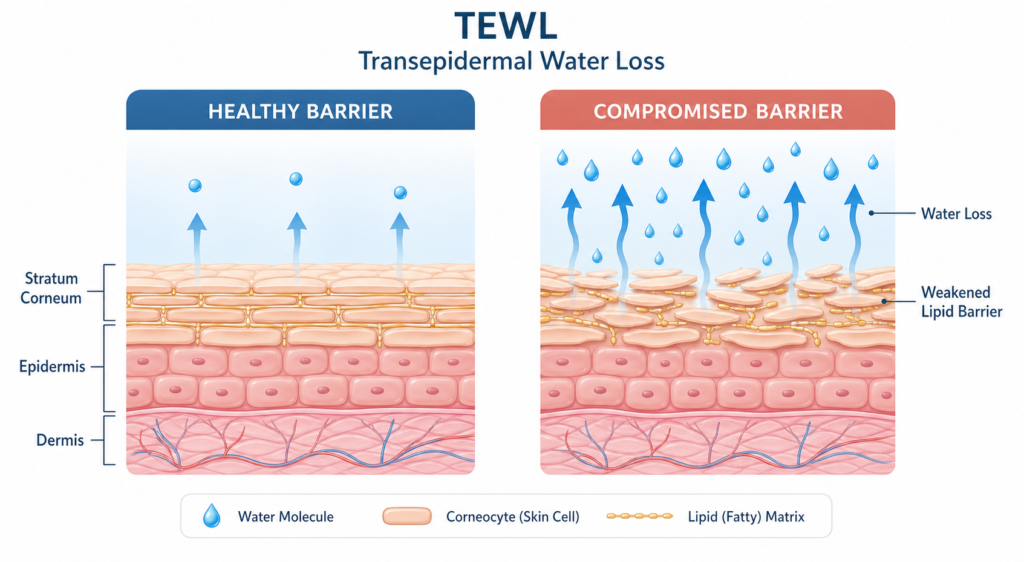
TEWL stands for transepidermal water loss, which is the amount of water that passively evaporates from the skin into the surrounding air. This is a normal, continuous physiological process; some water loss is always happening. The problem starts when it happens too fast.
TEWL is used clinically as a direct measure of skin barrier integrity. The higher the TEWL, the more compromised the barrier. When the barrier is functioning well, water stays in. When it’s damaged, water escapes faster than the skin can replenish it, leading to chronic dryness and sensitivity regardless of how much product you apply on top.
The Barrier Doing the Work: Stratum Corneum
The skin’s outermost layer, the stratum corneum, is the structure responsible for controlling TEWL. Its architecture is often described using a “brick and mortar” model:
- The bricks are corneocytes: flattened, protein-filled dead cells stacked in overlapping layers
- The mortar is a mixture of lipids, specifically ceramides, cholesterol, and fatty acids in an approximately 50:25:25 ratio, that fill the gaps between cells
Ceramides are the most critical component of this mortar. When ceramide levels drop due to aging, over-exfoliation, or harsh cleansers, the intercellular gaps widen, the barrier becomes leaky, and TEWL rises. Research shows that a decrease in ceramide content is directly associated with increased TEWL and conditions like atopic dermatitis.
Hydration vs. Moisture: The Actual Difference
These two words are used interchangeably in marketing, but they describe two distinct functions:
- Hydration = the water content inside skin cells. It’s addressed by humectants, which attract water molecules into the skin from the environment or deeper skin layers.
- Moisture = the barrier’s ability to hold onto that water and prevent it from evaporating. It’s addressed by emollients and occlusives, which reinforce the barrier and slow water loss.
Here’s why this distinction matters practically: humectants like hyaluronic acid and glycerin draw water into the skin. But without something on top to seal it in, that water can evaporate right back out, potentially making TEWL worse in a dry environment. Humectants fill the bucket. Occlusives put a lid on it. You need both sides of the equation.
What Damages the Barrier and Raises TEWL
The following are among the most common causes of barrier disruption and elevated TEWL:
- Over-exfoliation — AHAs and BHAs used too frequently remove not just dead cells but viable ones beneath, stripping lipids and disrupting the ceramide layer
- High-pH or sulfate-heavy cleansers — surfactants like SDS (sodium dodecyl sulfate) disorder stratum corneum lipids and raise TEWL measurably with repeated use
- Hot water and long showers — direct contact with hot water is objectively shown to increase TEWL and erythema; longer exposure compounds the effect
- Retinoid adjustment period — rapid cell turnover during the early weeks of retinoid use temporarily weakens the barrier
- Low-humidity environments — central heating, air conditioning, and winter air all accelerate TEWL by increasing the evaporation gradient between skin and air
The Three Ingredient Types That Manage TEWL
Understanding the three moisturizer categories is the practical core of managing TEWL:
Humectants attract water into the skin. They’re the hydration part of the equation.
- Examples: hyaluronic acid, glycerin, urea, panthenol, sodium PCA
- Best applied to damp skin and always followed by an emollient or occlusive to prevent the drawn-in water from evaporating
Emollients fill gaps between skin cells, softening texture and reinforcing the barrier without actively drawing in water.
- Examples: squalane, ceramides, fatty acids (linoleic acid, oleic acid), shea butter
- The workhorse of most moisturizers; improve both feel and function
Occlusives form a physical film on the skin surface that physically slows water evaporation.
- Examples: petrolatum (most effective), dimethicone, beeswax, lanolin, mineral oil
- Best used as the final layer in an evening routine
Layering logic: apply in order of thinnest to thickest — humectant first, then emollient, then occlusive. This sequence ensures each layer can penetrate before being sealed in.
| Type | What It Does | Key Examples |
|---|---|---|
| Humectant | Attracts water into skin | Hyaluronic acid, glycerin, urea |
| Emollient | Fills cell gaps, softens, reinforces barrier | Squalane, ceramides, fatty acids |
| Occlusive | Seals surface to slow water evaporation | Petrolatum, dimethicone, lanolin |
Can You Measure TEWL at Home?
Clinical TEWL measurement uses a device called a tewameter. This isn’t accessible at home but there are reliable proxy indicators that your TEWL is elevated:
- Tightness immediately after cleansing — a well-functioning barrier recovers quickly; prolonged tightness suggests the barrier was stripped
- Flakiness over otherwise smooth areas — not dry skin type, but active barrier disruption
- Products that didn’t previously sting now do — a leaky barrier means less protection against irritants
- Skin feels dry again within hours of moisturizing — water is going in but not staying
These signs don’t replace clinical measurement, but they’re consistent enough to be actionable. If multiple are present at once, the routine likely needs more occlusion and less actives, not more hydration.
How to Actually Lock Your Barrier
A practical checklist for reducing TEWL and supporting barrier recovery:
- Use a low-pH, gentle cleanser — avoid sulfate-heavy formulas that strip lipids (see here on cleanser pH)
- Limit exfoliation frequency — 2–3 times per week maximum; reduce further if barrier signs are present
- Layer in the right order — humectant → emollient → occlusive; don’t skip the sealing step
- Include ceramide-containing products — they directly replenish the mortar that keeps the barrier intact
- Apply moisturizer to damp skin — locks in surface water before it evaporates
- Always wear SPF — UV exposure damages the barrier and raises baseline TEWL
🧪 Lab Verdict
TEWL is the mechanism behind most “my skin is always dry no matter what I use” complaints. Hydration gets water in; the barrier keeps it there, and most routines focus heavily on the first without addressing the second. The humectant → emollient → occlusive layering sequence is the logical order dictated by how each ingredient type functions. If your skin is reactive, tight, or sensitive despite a full routine, the fix is usually less actives and more occlusion, not more hydrating serums.
References
- Rajan P, Maibach HI. “Transepidermal water loss (TEWL): Environment and pollution — A systematic review.” Contact Dermatitis. 2022;87(1):1–9. PMC9168018
- Fluhr JW, Darlenski R, Surber C. “Glycerol and the skin: holistic approach to its origin and functions.” British Journal of Dermatology. 2008;159(1):23–34.
- Elias PM. “Stratum corneum defensive functions: an integrated view.” Journal of Investigative Dermatology. 2005;125(2):183–200.
- Meckfessel MH, Brandt S. “The structure, function, and importance of ceramides in skin and their use as therapeutic agents in skin-care products.” Journal of the American Academy of Dermatology. 2014;71(1):177–184.
- Lodén M. “Role of topical emollients and moisturizers in the treatment of dry skin barrier disorders.” American Journal of Clinical Dermatology. 2003;4(11):771–788.
- Fluhr JW, et al. “Cleansing formulations that respect skin barrier integrity.” Dermatology. 2012. PMC3425021
- Darlenski R, Fluhr JW. “Impact of water exposure and temperature changes on skin barrier function.” Journal of Dermatological Science. 2014;75(3):141–147.
Leave a Reply