
Your skin is not sterile, and that’s a good thing. The trillion-plus microorganisms living on its surface aren’t invaders to be eliminated; they’re active participants in how your skin functions. The problem is that a multi-billion dollar industry has built a marketing language around this science that runs well ahead of what the evidence actually supports. Here’s what the microbiome research shows, and what it doesn’t.
What the Skin Microbiome Is
The skin microbiome is the collective community of bacteria, fungi, viruses, and mites that live on and in the skin. Different sites on the body host different communities. Oily areas like the nose and forehead favor different species than dry areas like the forearm, but a few key residents show up consistently.
- Staphylococcus epidermidis* is one of the most important. It actively produces antimicrobial peptides that suppress the growth of more harmful bacteria, and it helps calibrate the skin’s immune response.
- Cutibacterium acnes* (formerly P. acnes) has an undeserved reputation. In balanced amounts and in the right follicular environment, it’s a normal, harmless commensal.
- Malassezia*, a yeast, is present on virtually all human skin and plays a role in barrier lipid metabolism, though overgrowth is linked to dandruff and seborrheic dermatitis.
Together, these microorganisms help maintain the skin’s slightly acidic pH, reinforce the barrier, and train local immune cells to distinguish between harmless residents and genuine threats.
What Dysbiosis Looks Like
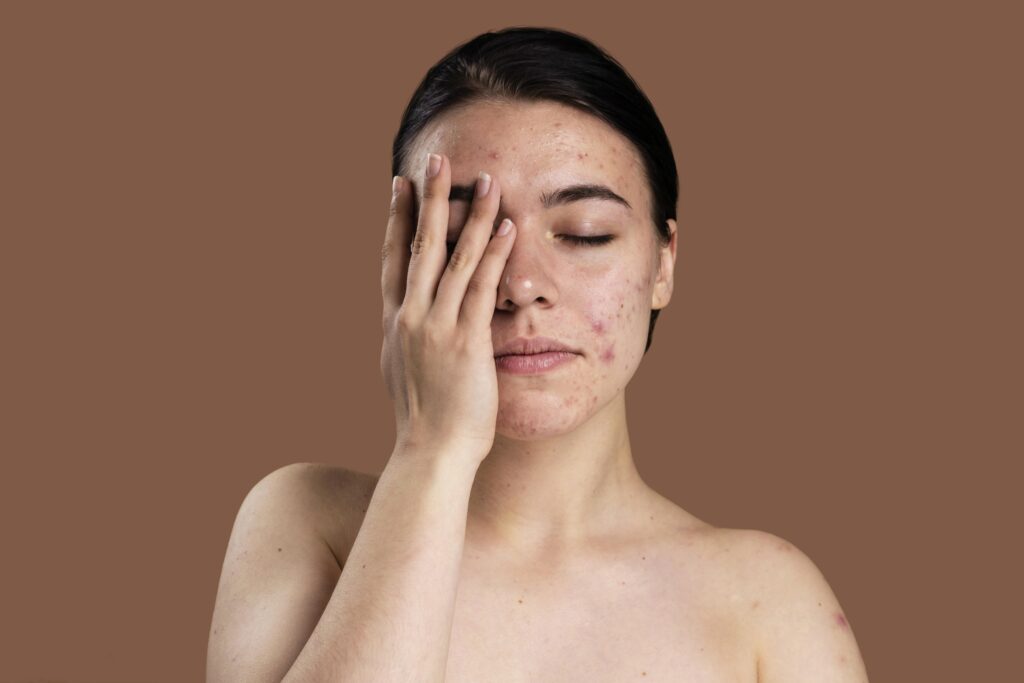
Dysbiosis means the microbial community has fallen out of balance. Not necessarily that harmful bacteria have moved in, but that the normal diversity and ratio of residents has shifted. The consequences are visible and well-documented:
- Acne — overgrowth of specific inflammatory C. acnes strains in low-oxygen follicles, triggering immune activation
- Atopic dermatitis (eczema) — S. aureus dominance displacing S. epidermidis, driving the chronic inflammation-barrier damage cycle
- Rosacea — reduced microbial diversity correlating with increased barrier permeability and flushing episodes
- Accelerated skin aging — dysbiosis feeds directly into the inflammaging loop: a disrupted microbiome triggers low-grade immune activation, which elevates cytokines, which degrades collagen
The pattern across all these conditions is the same: dysbiosis doesn’t just sit alongside skin problems, it actively drives them through barrier disruption and inflammatory signaling.
What Your Skincare Routine Does to Your Microbiome
This is the section most skincare marketing skips. The products you’re already using have a significant impact on microbial balance — often more than any probiotic serum can compensate for.
Over-cleansing is the most common disruptor. High-pH cleansers (above pH 6) alter the acid mantle and remove commensal bacteria alongside sebum and debris. Twice-daily cleansing with a harsh formula can shift microbial populations measurably within days.
Overuse of actives, particularly high-concentration acids used frequently, reduces microbial diversity on the surface, which isn’t inherently harmful in small doses but becomes problematic with chronic overuse.
Fragrance and certain preservatives, particularly those in leave-on products, have demonstrated antimicrobial activity that is not selective — they disrupt beneficial bacteria alongside harmful ones.
The practical implication: a microbiome-disrupting routine isn’t fixed by adding a probiotic serum at the end.
Probiotic, Prebiotic, Postbiotic — What the Labels Mean
Three terms dominate microbiome skincare marketing, and they’re frequently misused:
- Probiotic — live beneficial microorganisms. In food (yohurt, kefir), these have a documented evidence base. In skincare, live bacteria cannot survive the preservation requirements of a cosmetic formula. What’s marketed as “probiotic” almost always contains bacterial extracts, ferments, or lysates — not live cultures.
- Prebiotic — ingredients that feed beneficial bacteria already on the skin, such as certain sugars and fermented extracts. Theoretically sound, but the in-vivo skin evidence is limited.
- Postbiotic — the metabolic byproducts of bacteria: peptides, organic acids, enzymes. This is the most evidence-supported category in topical skincare. Lactobacillus ferment filtrate, for example, has shown measurable anti-inflammatory and barrier-supportive effects in controlled studies.
The honest summary: postbiotics have the most credible topical evidence, prebiotics are plausible but under-researched, and most “probiotic” skincare is a label claim built on consumer association with the gut health trend.
What the Science Says Actually Works
The most microbiome-supportive skincare strategy isn’t a specific product. It’s a routine design principle. Evidence consistently points to the same foundations:
- pH-balanced cleansers (pH 4.5–5.5) preserve the acid mantle and reduce disruption to commensal populations
- Barrier repair ingredients: ceramides, cholesterol, and fatty acids in the right ratio restore the physical environment that a healthy microbiome depends on
- Fragrance-free, minimal-preservative formulations in leave-on products reduce chronic low-level antimicrobial exposure
- Postbiotic ingredients (lactobacillus ferment filtrate, galactomyces ferment filtrate) offer the most realistic route to microbiome support through a topical, with a modest but genuine evidence base
🧪 Lab Verdict
The skin microbiome is serious science, but most skincare products wearing that label are marketing a concept rather than delivering a mechanism. The research is clear that dysbiosis drives real skin problems, and that certain disruptions (over-cleansing, high-pH products, fragrance overload) shift microbial balance in measurable ways. What the evidence doesn’t yet support is the idea that applying a “probiotic” serum meaningfully restores that balance. The most microbiome-friendly routine is one that stops disrupting what’s already there — pH-appropriate cleansing, a solid barrier formula, and restraint with actives — not one stacked with ferment serums that live cultures never actually survived to reach.
References
- Byrd, A. L., Belkaid, Y., & Segre, J. A. (2018). The human skin microbiome. Nature Reviews Microbiology, 16(3), 143–155. https://doi.org/10.1038/nrmicro.2017.157
- Grice, E. A., & Segre, J. A. (2011). The skin microbiome. Nature Reviews Microbiology, 9(4), 244–253. https://doi.org/10.1038/nrmicro2537
- Nakatsuji, T., et al. (2017). Antimicrobials from human skin commensal bacteria protect against Staphylococcus aureus and are deficient in atopic dermatitis. Science Translational Medicine, 9(378). https://doi.org/10.1126/scitranslmed.aah4680
- Lynde, C. W., et al. (2016). The skin microbiome in atopic dermatitis and its relationship to emollients. Journal of Cutaneous Medicine and Surgery, 20(1), 21–28. https://doi.org/10.1177/1203475415605498
- Espinal-Perez, L., et al. (2021). Postbiotics and their potential applications in skincare. Cosmetics, 8(3), 73. https://doi.org/10.3390/cosmetics8030073
- Dréno, B., et al. (2016). Microbiome in healthy skin, update for dermatologists. Journal of the European Academy of Dermatology and Venereology, 30(12), 2038–2047. https://doi.org/10.1111/jdv.13965
Leave a Reply