
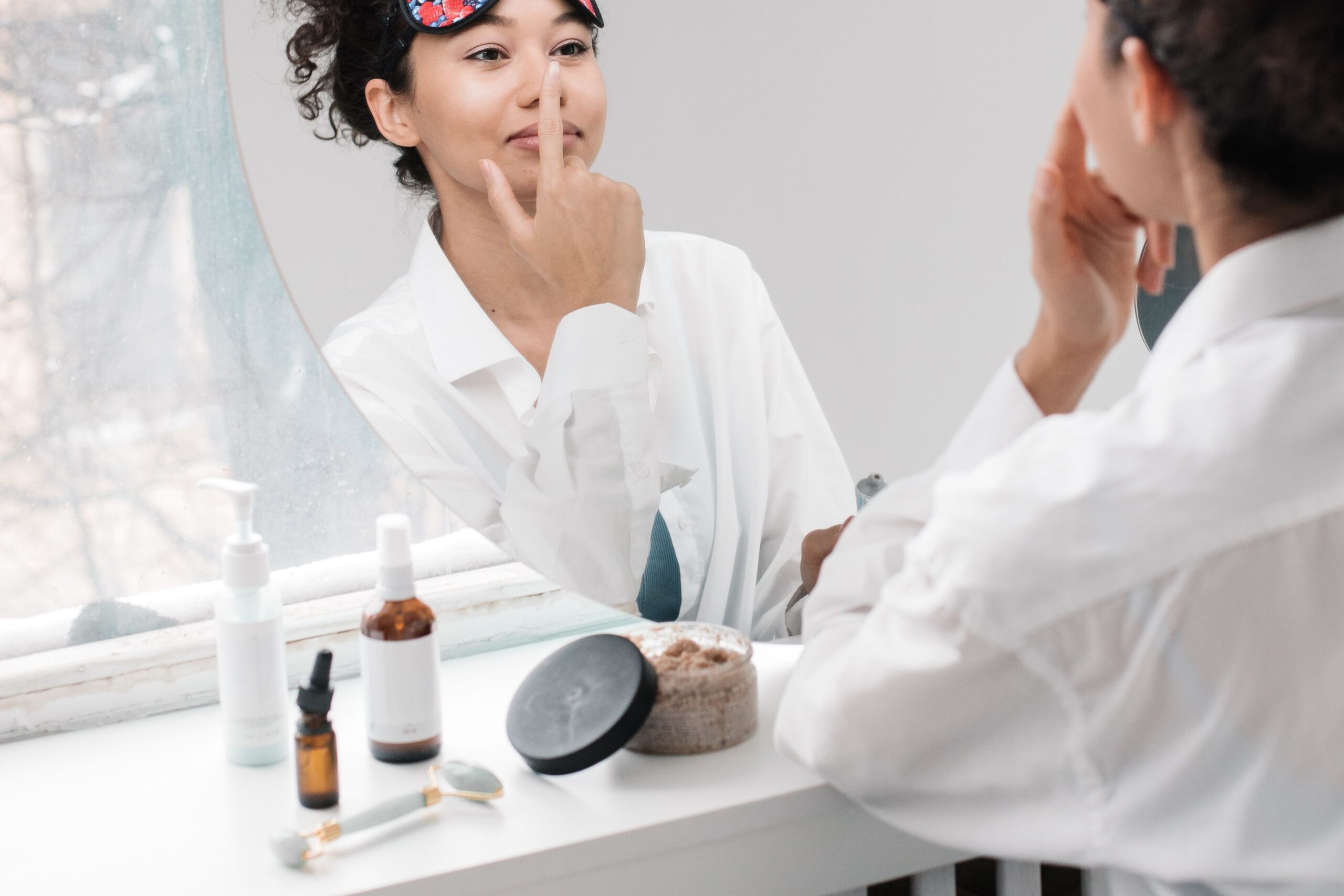
There is no single routine that works for everyone. Skin type, climate, age, and goals all change what belongs in your lineup. But that does not mean layering is random. There is a real logic behind product order, and once you understand it, routines become much easier to build and much less likely to irritate your skin. General dermatology guidance consistently recommends applying lighter products before heavier ones, because thicker formulas can limit the absorption of thinner treatments placed on top.
Think of this article as the framework underneath every good routine. The products may change, but the principles do not.
Start With the Basic Rule
The simplest rule is still the most useful: apply products from thinnest to thickest. Watery formulas go on first, then serums, then creams, then heavier oils or occlusives. This order gives lighter products the best chance to reach the skin before thicker layers form a barrier over them.
That rule is less about skincare tradition and more about physics. A rich cream or balm creates a more occlusive film on the skin, which is helpful at the end of a routine because it slows water loss and helps seal in hydration. But if you put that occlusive layer on too early, it can make later water-based treatments harder to deliver cleanly and evenly. The practical rule remains: light first, heavy last.
A simple example:
- Hyaluronic acid serum before moisturizer
- Vitamin C serum before face oil
- Retinoid before a thick sleeping mask
- Sunscreen after moisturizer, never underneath it
Texture Is Only the First Filter
Texture helps, but it is not the whole story. If two products feel similar, you then look at function. Treatment products usually go on before products whose main job is to moisturize or seal. In other words, the formula trying to change something in the skin usually needs closer contact with the skin than the formula trying to protect the surface.

This is why a plain moisturizer should usually follow an active serum, not come before it. It is also why oils are usually later in the routine. Oils are not bad for penetration by definition, but they are better treated as finishing layers than opening layers in most routines.
A helpful mental model is this:
- Clean the skin.
- Deliver the treatment.
- Support the barrier.
- Protect the skin from the outside world.
That sequence works far better than memorizing a rigid 8-step routine.
Where pH Comes In
Some ingredients are not just sensitive to order. They are sensitive to environment. This is where pH matters. Low-pH actives, especially L-ascorbic acid and exfoliating acids, perform best under acidic conditions. Vitamin C penetration depends heavily on pH, and L-ascorbic acid is known to absorb best at a low pH rather than at a more neutral one.
That does not mean you need to turn every routine into a chemistry experiment. It does mean that if you are using a low-pH vitamin C serum, or an AHA/BHA exfoliant, it makes sense to apply it early in the routine, directly after cleansing, before heavier or more neutral products.
In practical terms:
- Vitamin C usually goes on clean skin in the morning, before moisturizer and sunscreen.
- AHAs/BHAs usually go on after cleansing, before richer layers.
- Barrier creams and moisturizers come later, after treatment products have had contact with the skin.
People often overcomplicate the waiting time question. You do not need a 20-minute gap between every product. In most cases, a brief pause is enough, just long enough for a layer to spread evenly and settle before the next one. The bigger issue is not waiting. It is stacking too many strong actives into one routine and then blaming the order.
A Simple Order for Most Routines
Here is the most useful general sequence for day-to-day skincare:
| Step | Morning | Evening |
|---|---|---|
| 1 | Cleanser | Cleanser |
| 2 | Optional toner or essence | Optional toner or essence |
| 3 | Treatment serum or active | Treatment serum or active |
| 4 | Moisturizer | Moisturizer |
| 5 | Sunscreen | Optional occlusive or sleeping layer |
This is the base structure, not a rule that every person needs every day. Some people do not need toner. Some do not need a morning cleanser. Some use just cleanser, moisturizer, and sunscreen. The point is the logic, not the number of steps.
Here is where some of your existing actives usually fit:
| Ingredient | Usual Place in Routine | Best Timing |
|---|---|---|
| Vitamin C | Early, after cleansing | Morning |
| Azelaic acid | After cleansing, before moisturizer | Morning or night |
| Benzoyl peroxide | After cleansing, before moisturizer | Often night, sometimes morning |
| Retinoids | After cleansing, before moisturizer | Night |
| Peptides | Before moisturizer | Morning or night |
| Caffeine Eye serum | After cleansing, before cream | Morning |
This is also where internal logic matters more than internet rules. If your retinoid is in a cream base and your serum is extremely watery, the serum may still go first. If your skin is very reactive, you might sandwich a retinoid with moisturizer to reduce irritation.
When the Order Changes
The skeleton of a routine stays fairly stable. The details shift based on your skin.
Skin type
Oily skin usually tolerates lighter finishing layers. Dry skin often needs richer creams or an occlusive step at night. That changes the end of the routine more than the beginning.
Primary concern
An acne routine may prioritize benzoyl peroxide, salicylic acid, or azelaic acid. A pigmentation routine may put more emphasis on vitamin C, azelaic acid, and sunscreen. An anti-aging routine may center on retinoids and daily UV protection. Same framework, different treatment slot.
Season and climate
Humid weather usually reduces the need for heavy finishing layers. Cold or dry weather often increases the need for richer moisturizers and barrier support. That is one reason there can never be a single universal routine that works year-round.
Tolerance
The best-ordered routine is still a bad routine if it overwhelms your skin. Sometimes the right answer is not better layering. It is fewer actives.
The Most Common Layering Mistakes
A lot of routine problems come from a few repeated errors.
- Applying a heavy oil before a water-based treatment, which can make later layers feel like they are sitting on top rather than spreading evenly.
- Using too many strong actives at once, especially acids plus retinoids plus benzoyl peroxide in the same session.
- Putting sunscreen anywhere except the final morning step. Sunscreen needs to form an even protective film over the skin, which is why dermatologist guidance consistently places it last.
- Believing more layers automatically mean better results. In reality, more steps often just increase pilling, irritation, and confusion.
If a routine keeps failing, the first thing to audit is the order, the overlap, and the number of treatment steps.
FAQs
Does skincare order really change results?
Yes. Product order affects how well formulas contact the skin and how likely they are to pill, irritate, or get blocked by heavier layers. Dermatology guidance consistently favors lighter-to-heavier sequencing for that reason.
Should sunscreen always go last in a skincare routine?
Yes, in a morning routine sunscreen should be the final skincare step so it can form a more even protective layer.
Can you layer too many products at once?
Not a good idea. Even if the order is technically correct, too many actives in one routine can increase irritation and make it harder to tell what is helping or hurting.
🧪 Lab Verdict
There is a repeatable logic behind product order. Start with lighter layers, place treatment products before barrier-sealing ones, give low-pH actives early access to the skin, and keep sunscreen as the final morning step. After that, the best routine is the one shaped around your skin’s needs, not a trend, not a 10-step template, and not somebody else’s shelf.
References
- Dermatologist Shares the Best Order to Apply Your Skincare Products. MyBeautyMD. https://www.youtube.com/watch?v=GLtZQAKHRgM
- Vitamin C and Skin Health. Oregon State University Micronutrient Information Center. https://lpi.oregonstate.edu/mic/health-disease/skin-health/vitamin-C
- Pullar, Juliet M et al. (2017). The Roles of Vitamin C in Skin Health. Nutrients, 9(8), 866. https://pmc.ncbi.nlm.nih.gov/articles/PMC5579659/
- Pellanda, C et al. (2007). Topical bioavailability of triamcinolone acetonide: effect of occlusion. Skin pharmacology and physiology, 20(1), 50–56. https://pubmed.ncbi.nlm.nih.gov/17035722/
- How to Layer Skin Care Properly, According to Experts. https://www.today.com/shop/how-to-layer-skin-care-rcna196953
- The Correct Order to Apply Skincare: A Dermatological Guide. https://www.dermawise.co/blog/correct-skincare-application-order
Leave a Reply